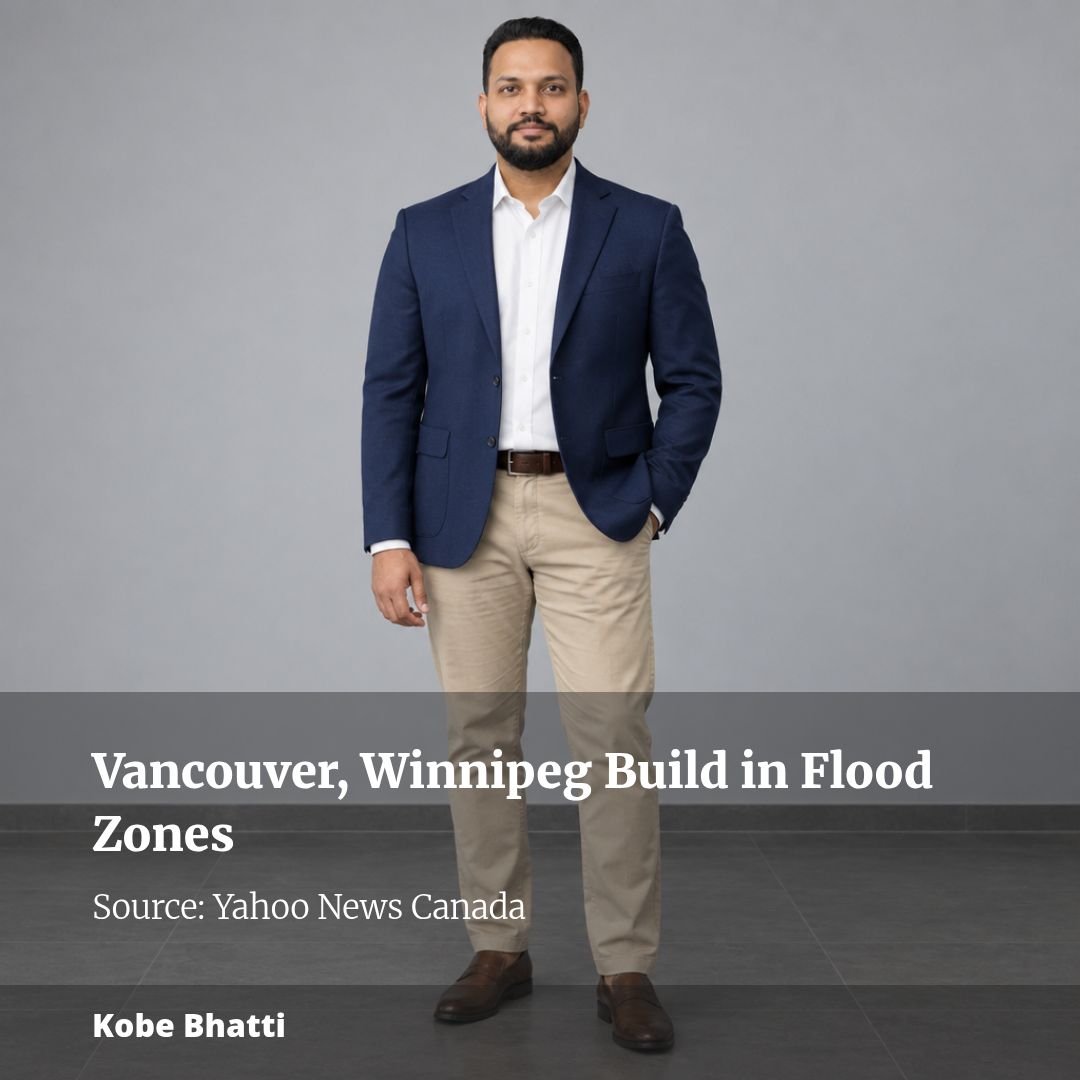
Author: Kobe Bhatti

  • Vancouver, Winnipeg Expand Housing with Resilient Flood Zone Plans

    Vancouver, Winnipeg Expand Housing with Resilient Flood Zone Plans

    As someone deeply involved in both residential and commercial real estate across Vancouver and the Fraser Valley, I pay close attention to how urban growth intersects with environmental realities. StatsCan recently highlighted that cities like Vancouver, Winnipeg, Chatham-Kent, and Chilliwack are seeing more homes built in high flood hazard areas. In particular, recent construction has increased in Manitoba, Saskatchewan, and B.C. as communities work to address housing shortages. For those navigating our region’s evolving landscape, understanding where new homes are being developed—and the unique risks that come with these locations—is essential for making confident, well-informed decisions. My commitment to ethical guidance and community development means I’m always watching these trends to help clients build a secure future.


    Continue to full article

  • Home sales remain low but recovering slowly, says BCREA

    Home sales remain low but recovering slowly, says BCREA

    As someone dedicated to guiding clients through the Vancouver and Fraser Valley real estate markets, I pay close attention to shifts like these: Recent data from the BCREA shows that residential home sales in British Columbia totaled $5.2 billion in August, a 4.8% decrease, with average prices dipping by 1% to $924,826. Sales volume also slid 5.5% to 46,069 homes. In Greater Vancouver, we’re seeing a 1.3% drop in prices and 3.6% fewer sales. While activity remains lower than previous highs, the gradual nature of these changes speaks to a market in slow recovery, not sudden upheaval. My background in both business and healthcare has taught me the importance of careful analysis and ethical decision-making—qualities I bring to every client relationship, especially in times of transition like these.

    Continue to full article

  • Canada Housing Could Look Very Different in 2027

    Looking ahead to 2027, we're likely to see a shifting landscape for Canadian housing. According to CMHC, as incomes and the broader economy strengthen, housing conditions should gradually improve. While sales are expected to rebound, they may not reach the highs of the past decade. The Canadian Real Estate Association anticipates only modest growth in national home prices, pointing toward a period of stabilization rather than another dramatic surge. For buyers, higher inventory and softer demand in certain markets could mean more room to negotiate. In my own practice across Vancouver and the Fraser Valley, I believe these trends underscore the value of informed, strategic decision-making—something I’m committed to fostering for clients, whether they’re seeking a home or expanding their investment portfolio.

  • BC Standing Inventory Reached 6.7K

    BC’s standing inventory has reached 6,700 homes, with 5,500 of those being condos. This snapshot covers condos, townhomes, and select multiplex units across the province. Looking closer at key areas: Burnaby currently leads with 1,210 unsold homes, followed by Vancouver at 1,020, Surrey at 798, and Coquitlam at 620. Richmond, Kelowna, Langley Township, New Westminster, and Delta all show significant numbers as well, reflecting how inventory is distributed well beyond just the largest cities. Other regions, including Langford, Esquimalt, City of North Vancouver, Abbotsford, and Chilliwack, contribute to a total of 5,840 listings in the cities tracked. There’s often talk that unsold presales are mainly studios and one-bedrooms, but wider data on home size and average price across BC tells a different story. In my work serving buyers and sellers in Vancouver and the Fraser Valley, understanding these dynamics is essential to supporting informed, community-focused decisions.

  • National Day for Truth and Reconciliation

    National Day for Truth and Reconciliation honours survivors and raises awareness about their experiences.
    It's a symbol of Canada's commitment to reconciliation with Indigenous communities.
    Wearing orange shirts on this day symbolizes respect for survivors and raises awareness about residential schools.
    May this day inspire a future where every voice is heard, and every spirit is healed.
    Together, we can create a tomorrow filled with hope and endless possibilities.

  • Metro Vancouver and Fraser Valley Sales Soften

    As someone deeply connected to Metro Vancouver and the Fraser Valley’s real estate landscape, I’ve been closely tracking this season’s market dynamics. In Mid-Q3, we saw 1,900 residential sales—a softer end to summer 2026, with activity falling short of earlier projections for the year. The composite benchmark price in Metro Vancouver came in at $1.08M, marking a slight month-over-month dip as the market continued to tip in favor of buyers.

    Inventory has climbed to 15,800 active listings, giving buyers more options and ensuring strong competition among sellers. Detached homes experienced the biggest adjustment, with a benchmark price of $1.8M, while apartments settled at $686K and attached homes at $1.03M. The sales-to-active listings ratio is now around 12%, a clear indicator of a buyers’ market with plenty of selection and more room for negotiation.

    My background in both residential and commercial real estate, combined with analytical skills honed through my MBA and my commitment to informed decision-making, allows me to guide clients through evolving conditions like these. I’m always focused on long-term relationships and supporting our community—especially when the market shifts and opportunities arise.

  • BC Standing Inventory Data By City, Size, And Average Price

    BC Standing Inventory Data By City, Size, And Average Price

    BC currently has 6,687 unsold residential units, with the highest numbers in Burnaby, Vancouver, and Surrey. While condos make up much of this inventory, it’s important to recognize that the available units span a range of sizes—painting a more nuanced picture of our market than the numbers alone might suggest. In my experience working across Vancouver and the Fraser Valley, understanding these subtleties is key to making confident, informed choices in both residential and commercial real estate. I always aim to provide insights that go beyond the headlines, so clients can navigate this complex landscape with clarity and confidence.

    Continue to full article

  • Check out my listing, Address: 228 SCHOOLHOUSE Unit #12, Coquitlam, British Columbia V3K6V7

    Prime Retail/Restaurant Opportunity in Coquitlam! Exceptional opportunity to lease a professionally improved commercial unit in Coquitlam's highly sought-after Schoolhouse retail district. This is a well-established restaurant featuring a 14ft commercial kitchen hood, allowing food service operators to significantly reduce startup costs. Zoning also permits a wide range of retail, medical, health, office, and service commercial uses. Ideally situated just north of Lougheed Highway with exposure to over 10000 vehicles per day (as per the City), the property is surrounded by major national retailers including IKEA, Superstore, Canadian Tire, Staples, HomeSense, and SilverCity. Ample on-site parking, excellent accessibility, and a thriving commercial environment make this an outstanding opportunity in one of the Tri-Cities' premier retail destinations. Business assets available for purchase separately. Please do not disturb the business/staff, Call Listing Agent for appointment. (id:26452)

  • Canada Fee Cuts Could Unlock Supply

    Development fees play a significant role in shaping new-home costs across Canada, and recent findings from a national housing agency highlight just how impactful adjusting these fees could be. For instance, cutting development fees could make about 14% more residential projects viable—an especially notable change in cities like Toronto and Vancouver. In these markets, removing these charges could mean a roughly 10% increase in feasible projects, with Toronto potentially able to address half of its stated supply needs. When we look at Calgary, development fees range from approximately $4,000 for a one-bedroom high-rise to about $9,000 for detached homes—substantially less than Vancouver’s $20,000 to $33,000 for similar properties. While these fees are crucial for funding infrastructure like roads, sewers, and administration, the agency’s economist points out that the ideal level isn’t zero. Instead, reducing fees—especially on family-sized homes—might help new projects compete in high-cost markets, where larger new builds often outprice comparable resale homes and become less accessible for families. In my experience working with both residential and commercial properties in Vancouver and the Fraser Valley, I’ve seen how these cost dynamics influence real opportunities for buyers and the broader community. Understanding these factors can empower clients to make informed decisions and foster more sustainable, long-term growth in our neighborhoods.

  • Canada: Rate Cuts Can Worsen Affordability

    A recent study by central bank researchers sheds light on why rate cuts alone don’t solve Canada’s housing affordability puzzle. When borrowing costs drop, we see resale activity jump quickly—often with the full impact showing up 18 to 24 months after the rate cut. Yet, new housing starts only begin to pick up about two years later, as builders need time for planning, permitting, and making projects viable, especially with multi-unit homes. Strong labour markets can make these effects even more pronounced, encouraging buyers who feel confident in their financial outlook. Ultimately, while lower rates may eventually spur more supply, demand always gets there first—so relying solely on monetary policy isn’t the answer to affordability. This dynamic is something I watch closely in Vancouver and the Fraser Valley, as understanding the timing between policy shifts, buyer demand, and new construction is crucial for anyone navigating our local markets.